A short selection of past technical projects by PhaseZero associates.
Technical portfolio

Counting People in Crowds
Estimating the number of people in a crowded environment is a central task in civilian surveillance. Most vision-based counting techniques depend on detecting individuals in order to count, an unrealistic proposition in crowded settings. It is possible to count people in crowds without explicitly detecting persons in each image frame? The answer is yes. In…

Reduced Homographies
In Computer Vision, the homography is a 3×3 transformation between any two images of the same planar surface in space. Furthermore, if a the 3-D positions of a set of fiducials are known, the homography also determines the absolute position and orientation of the camera with respect to said set of fiducials. Suppose that for some reason…
Video Warping with Mobile GPUs
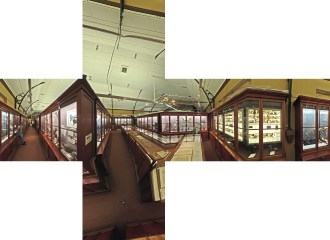
This project involved the real-time warping (2-D spatial transformation) of 1080p video frames on-board a mobile phone. The implementation uses hardware GPU for practically 100% of the computation. It required the development of an efficient warping algorithm running in parallel on fragment shaders. The algorithm was coded in OpenGL Shading Language (GLSL).. Due to confidentiality agreement…

Sparse Image-based Rendering
The goal of sparse image-based rendering (IBR) is to synthesize novel views of a scene given images from a small set of cameras views. The sparseness constraint prevents the use of light-fields or similar techniques that require a relative dense sampling of the plenoptic function. One approach to sparse IBR is to capture the scene geometry with…

On-the-fly Group-Forming Networks
In 2012, we developed the concept of audience-forming network (or group-forming network). This work started in a now defunct company, but the effort later moved to PhaseZero. The idea of an audience-forming network (AFN) is to provide engagement spaces so that any interacting group of individuals could potentially become an audience. The spontaneous formation of specific…
Real-time Combinatorial Target Tracking
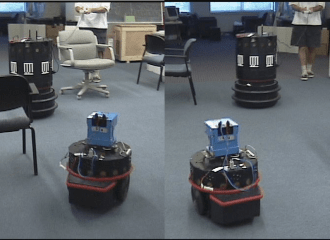
Many applications require continuous monitoring of a moving target by a controllable vision system. Visual servos usually ignore the presence of obstacles and focus on imaging and target recognition issues. For a target moving among obstacles tracking is quite complex: a controllable observer (e.g., a robot) must anticipate that the target may become occluded by an obstacle…
 PhaseZero